
Pharmacy
Pharmacy
Approximately 100 people are involved in the pharmacy's activities: pharmacists, pharmacy technicians and laboratory technicians, pharmacy interns and students, administrative staff, handling staff, storekeepers, nurses and nursing assistants for sterilization.
Pharmacy opening hours:
- Monday to Friday, 9:00 AM to 5:00 PM
- Saturday from 9:00 am to 12:30 pm
Opening of the outpatient dispensing system (dispensing medication to non-hospitalized patients):
- Monday, Tuesday, Wednesday, Thursday and Friday from 9:00 a.m. to 5:00 p.m
- Saturday from 9:00 am to 12:30 pm
Approximately 100 people are involved in the pharmacy's activities: pharmacists, pharmacy technicians and laboratory technicians, pharmacy interns and students, administrative staff, handling staff, storekeepers, nurses and nursing assistants for sterilization.
Pharmacy opening hours:
- Monday to Friday, 9:00 AM to 5:00 PM
- Saturday from 9:00 am to 12:30 pm
Opening of the outpatient dispensing system (dispensing medication to non-hospitalized patients):
- Monday, Tuesday, Wednesday, Thursday and Friday from 9:00 a.m. to 5:00 p.m
- Saturday from 9:00 am to 12:30 pm

Team
Service composition
- 2 university professors · hospital practitioner
- 1 senior health executive
- 1 healthcare manager
- 25 hospital practitioners
- 4 specialist assistants
- 43 preparers
- 8 IDE/ASH
- 6 administrative staff
- 5 skilled workers and logistics agents


Our activities
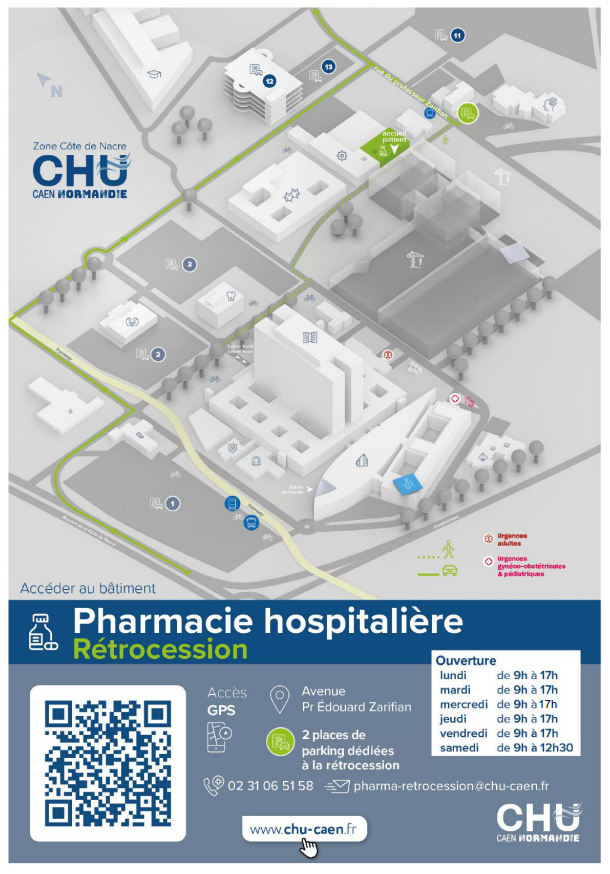
Your doctor has prescribed one or more medications that are only available in hospital pharmacies. Here are the steps to follow to pick up your medication at the university hospital pharmacy.
- To access the university hospital pharmacy, please refer to the map
- Bring your health insurance card, identity card, health insurance card if you have one, your prescription and come during our opening hours for the reimbursement (patient reception door).
- We recommend that you send these documents in advance to ctx-retrocession@chu-caen.fr whenever possible.
- For any further information related to your registration, you can call the secretariat at 02.31.06.46.66
- For any information regarding your treatment, you can call 02.31.06.51.58
- Your medication will be provided for one month.
In exceptional cases of issuance for more than one month in the event of departure abroad : please contact us beforehand.
For any inquiries regarding your pharmacy coverage, you can send an email to pharmacie-retrocession@chu-caen.fr
Useful links :
- OMéDIT site map, retrocession
- Clinical pharmacy films, SFPC,
Two parts :
- Support
- Patient documents on the proper use of medications
- Appointment booking for clinical trials
- Access for "pharmaceutical suppliers"

The pharmacy's main mission is to:
- To ensure the management, supply, verification of safety devices, preparation, control, storage, evaluation and dispensing of sterile medicines and medical devices and investigational medicinal products and to ensure their quality
- To dispense medications and medical devices to hospitalized patients based on prescriptions issued by hospital doctors or purchase orders. It also dispenses medications not available in pharmacies to outpatients (reimbursement activity).
- Manage the purchase, supply, control, storage and delivery of pharmaceutical products.
- To ensure the execution of certain sterile and non-sterile preparations, both hazardous and non-hazardous.
- To carry out information campaigns and participate in any initiative aimed at improving the quality and safety of treatments.
- To carry out all clinical pharmacy activities, namely to contribute to the safety, appropriateness and efficiency of the use of health products and to contribute to the quality of care, in collaboration with other members of the healthcare team and involving the patient
- Participate in the training of future pharmaceutical professionals in conjunction with the UFR Health and the Faculty of Pharmaceutical Sciences of Caen.
- Develop research projects with the UFR Health and the Faculty of Pharmaceutical Sciences of Caen
- Working with the Hospital Pharmacies of the Normandy Centre Hospital Group

- Centralized pharmaceutical analysis
- Early access
- Dispensing specific medications to outpatients (re-dispensing), link with the city
- Automation – computerization
- Management of incoming and outgoing flows
- Purchases
- Orders
- Markets: pharmaceuticals and medical devices
- Pharmaceutical technology:
- Hospital and magistral preparations within the preparatory department,
- Non-Hazardous Sterile Preparations Unit (NSHPU)
- Cancer Chemotherapy Preparation Unit (CPU)
- Laboratory for the control of preparations
- Innovative Therapy Drugs (ITDs)
- Radiopharmacy
- Medical fluids, medical gases and water for hemodialysis
- Sterilization of medical devices
- Clinical trials
- Quality assurance – risk management
- Vigilance:
participation in pharmacovigilance in conjunction with the CRPV and management of materiovigilance - University hospital training, teaching and research
- Facilitation of the Commission on Medicines and Sterile Medical Devices (COMEDIMS)
The challenges of the Optimédoc project:
Optimédoc is an interdisciplinary and multi-professional pathway for the elderly, based on a collaboration between community and hospital services. The attending physician, the community pharmacist, and the hospital support team, composed of a hospital pharmacist and a geriatrician, collaborate on the medication management of people aged 75 and over, taking multiple medications, whether hospitalized or not, who present a significant risk of iatrogenic effects (all adverse effects caused by taking one or more medications).
The objective of this approach is to optimize the medication management of elderly patients using decisions made during multidisciplinary team meetings between the city and the hospital.
The Optimédoc system:
The inclusion of elderly subjects at high risk of iatrogenic injury in the program is carried out:
- For patients residing in the city: following identification and referral by the attending physician to this system by telephone at 02 31 06 53 17.The
initial identification criterion is a prescription containing more than 5 medications in people aged 75 or over. - for hospitalized patients: following identification and intra-hospital referral to this system with the agreement of the attending physician and the patient.
The journey is divided into 4 stages:
- Inclusion
- Specialized evaluation
- Consultation
- Follow up



Logistics Building · Pharmacy · Administration
Pharmacy
For the pharmacy: Monday to Friday from 9am to 5pm · Saturday from 9am to 12:30pm

Hospital Pharmacy Access
Hospital Pharmacy Access
| Level | GPS access | Parking | Entrance | ||
|---|---|---|---|---|---|
Pharmacy Logistics Building · Pharmacy · Administration | Level : 0 | GPS access: Hospital pharmacy | Parking: Parking 9 |  | |
Retrocession Logistics Building · Pharmacy · Administration | Level : 0 | GPS access: Hospital pharmacy | Parking: Parking 9 | |
