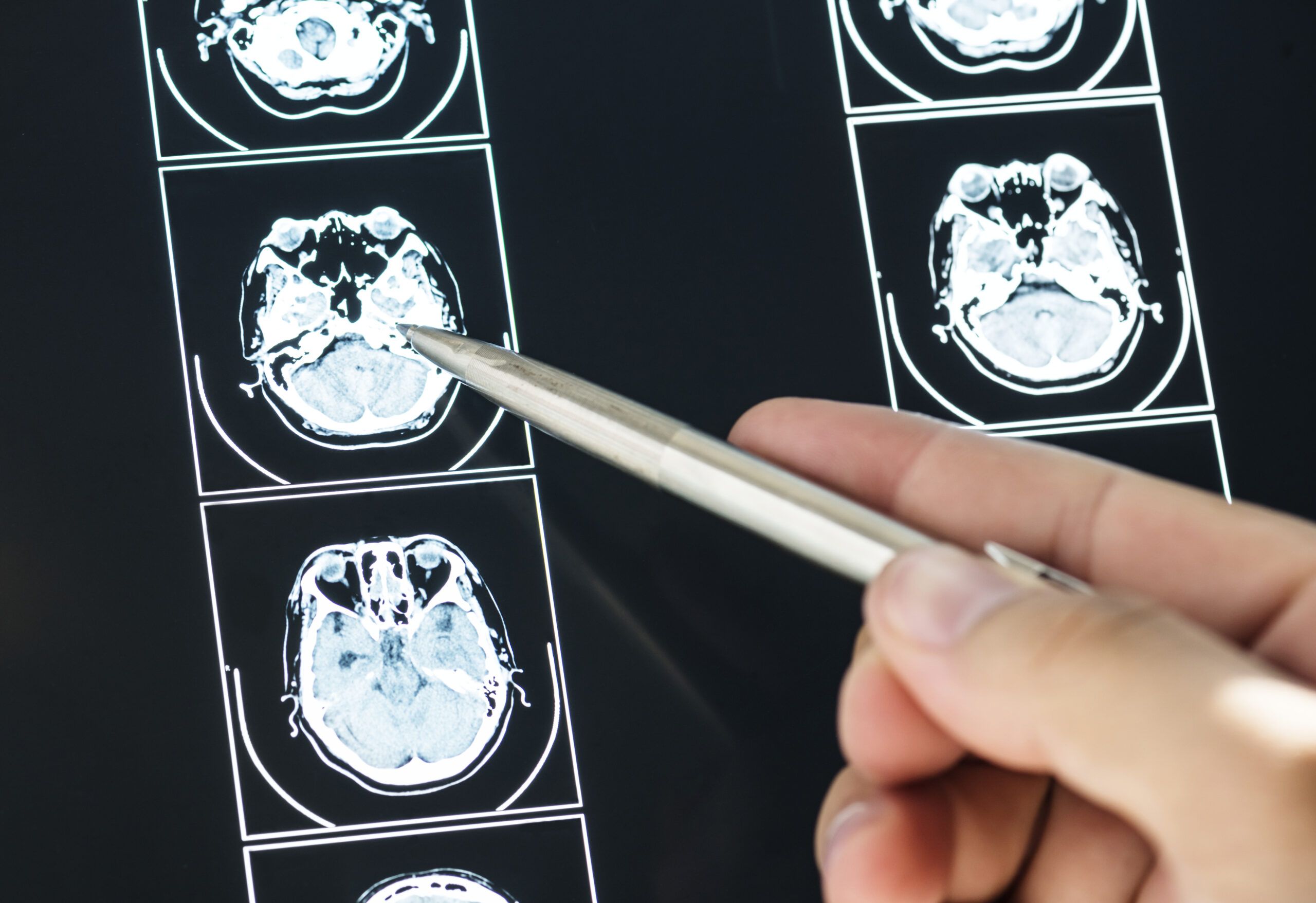
« Nous avons mis au point un nouveau produit de contraste qui permet de révéler la présence de microthrombi en imagerie par résonance magnétique » explique le Dr Thomas Bonnard, chercheur INSERM à l’institut Blood and Brain (laboratoire PhIND, INSERM U-1237).
Les thrombi sont des caillots qui obstruent les vaisseaux, bloquent l’irrigation sanguine du cerveau et provoquent un AVC.
Lorsqu’un patient souffrant d’un AVC est amené à l’hôpital par les services de secours, les médecins vont chercher à faire une imagerie de son cerveau le plus rapidement possible avec un scanner ou une imagerie par résonance magnétique (IRM). Avec les technologies actuelles, il est possible d’observer les vaisseaux du cerveau et comprendre ainsi où se trouve le bouchon, ce qui est déjà extrêmement utile pour choisir la meilleure intervention à réaliser. On peut également discerner les plus gros thrombi responsables de ces bouchons. Mais dans un certain nombre de cas, il y a des petits fragments de thrombi dispersés dans le cerveau du patient que l’on appelle microthrombi qui eux sont impossibles à observer, même avec les technologies d’imagerie dernier CRI.
C’est ici qu’intervient le produit de contraste inventé par la Dr Charlène Jacqmarcq et le Dr Thomas Bonnard. Ils ont développé des microparticules magnétiques destinées à être injectées dans la circulation sanguine et capables de se fixer aux microthrombi. Les propriétés magnétiques des microparticules confèrent un signal en IRM et permettent ainsi leur diagnostic. Avec ce nouveau produit de contraste appelé PHySIOMIC, on peut voir les microthrombi en IRM.
Le défi était complexe et la synthèse de ce produit de contraste a nécessité plusieurs années de développement et des expertises pointues en chimie et en ingénierie des matériaux. Il inclut notamment un matériau organique innovant qui utilise la dopamine comme matière première. La dopamine est un neurotransmetteur qui influence notre cerveau. Ici, cette même molécule est utilisée dans une éprouvette pour faire un matériau qui s’appelle la polydopamine. Un matériau qui se présente sous forme de gelée noire, totalement biodégradable et qui a des propriétés uniques en terme d’interaction avec les métaux. Les travaux de recherche de la Dr Charlène Jacqmarcq et du Dr Thomas Bonnard ont permis d’établir que cette polydopamine possédait une affinité spécifique pour les microthrombi. Pour synthétiser leur produit de contraste PHySIOMIC, ils ont assemblée cette polydopamine avec des matériaux magnétiques qui présentent un signal en IRM.