
Multidisciplinary Prenatal Diagnostic Center
A Multidisciplinary Prenatal Diagnostic Center is a structure that brings together a group of professionals, specialists in the care during pregnancy and at the time of delivery, of fetuses in which an anomaly is suspected or confirmed, or when there is a family history of malformation or genetic disease.


Team
- 1 university professor · hospital practitioner · gynecologist-obstetrician-ultrasound specialist
- 6 hospital practitioners · gynecologist-obstetrician-ultrasound specialist
- 4 hospital practitioners · pediatrician/neonatologist
- 1 university lecturer · hospital practitioner geneticist
- 2 hospital-based geneticists
- 2 midwives
- 3 hospital practitioners for pediatric cardiology
- 3 psychologists
Activities
The CPDPN responds to a regional reference activity concerning the diagnosis of fetal malformations, the carrying out of sampling and the discussion of each case within a multidisciplinary team (neonatal pediatrician, pediatric surgeon, psychologist, midwife, fetopathologist, obstetrician, sonographer, geneticist, child psychiatrist…).
For this purpose, the unit is equipped with high-level ultrasound scanners (2D, 3D, 4D and color Doppler), also used for normal pregnancy monitoring.
Meetings are held via videoconference with other hospitals and practitioners in the region, which improves the quality of discussions and patient care. Each case is presented only after obtaining the patient's consent and in strict compliance with medical confidentiality.
For any request for advice or appointment, please make it via the Omnidoc tele-expertise platform.
Sending us a request is very simple; just go to:
If you don't already have an Omnidoc account, you can create one for free in just a few seconds.
The platform is very intuitive to use, but if needed, you will find a tutorial attached explaining the different steps. In case of technical difficulties, you can contact support@omnidoc.fr; they are very responsive.
Here is also a video tutorial introducing the Omnidoc platform: (video tutorial).
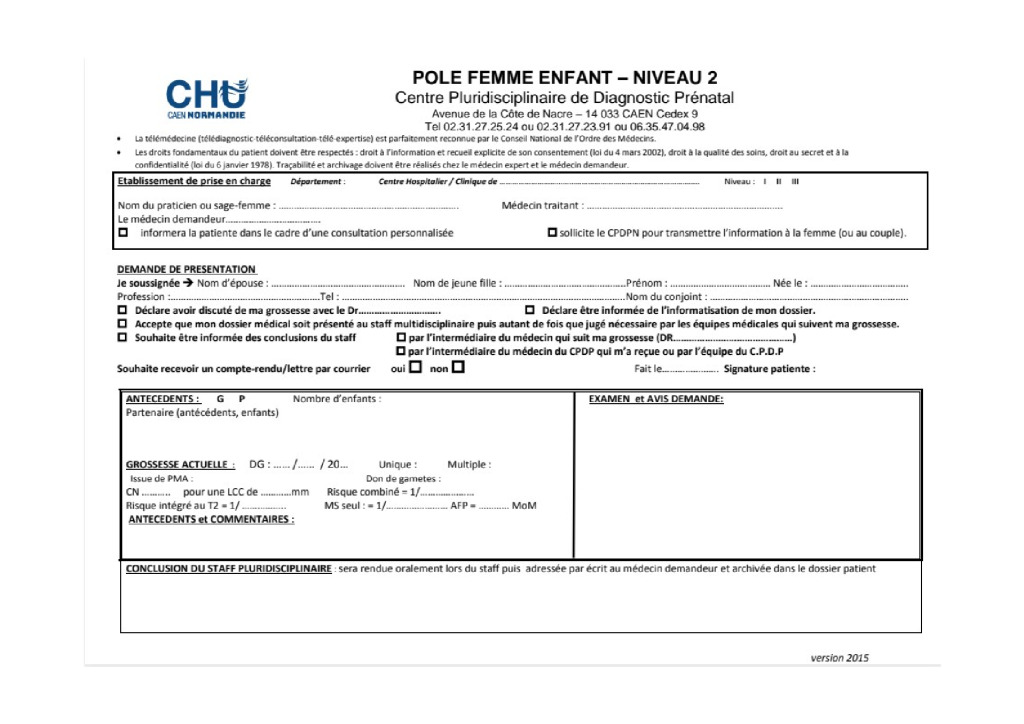
- For any presentation request, please contact the secretariat at 02 31 27 25 24 or by email in order to access the Norm-Uni platform.
To attend these follow-up appointments, please remember to bring all ultrasounds and test results from your pregnancy, as well as proof of your blood type (card or blood test results). If you have had a Down syndrome screening test , you should also have the results; if your doctor hasn't given them to you, ask for a copy.
The midwives will meet with you initially to explain how we operate, the course of your care, and to open your file.
The sonographer doctors will then see you to further examine the ultrasound and, if necessary, make a diagnosis.
Most often, the examination is reassuring and a return to usual ultrasound monitoring is possible.
However, sometimes an unusual finding is confirmed or detected, and follow-up care is arranged in our unit. Several tests may then be necessary to make a diagnosis.
If needed and with your consent, the images taken during the consultation will be presented at the Multidisciplinary Prenatal Diagnostic Center, which meets weekly. This committee includes other sonographers from the region, as well as geneticists, neonatologists, psychologists, pediatric radiologists, pediatric surgeons, and, depending on the case, physicians from other specialties. This committee will recommend a type of ultrasound monitoring for your pregnancy and/or any additional tests that may be necessary.
The suspicion of one or more organs with an unusual ultrasound appearance in your baby can generate anxiety, even if the tests ultimately come back reassuring.
Don't hesitate to make an appointment with one of the service's psychologists. They will work with you to decide on the support that will be put in place throughout your pregnancy.
Your follow-up at the Antenatal Diagnostic Unit
This could be indicated by:
- particular history in your family or that of the baby's father,
- personal medical history concerning you (malformations) or medical history in your spouse,
- the course of a previous pregnancy,
- the result of the Down syndrome screening,
- an incomplete examination or the unusual appearance of a fetal organ during your screening ultrasound,
- taking certain medications or toxins
- an ongoing infection such as toxoplasmosis or cytomegalovirus
- The type of pregnancy: we monitor monochorionic twin pregnancies (one placenta) and triplet pregnancies, even if they are progressing normally
- another particular situation (slow fetal growth, amniotic fluid abnormality…)
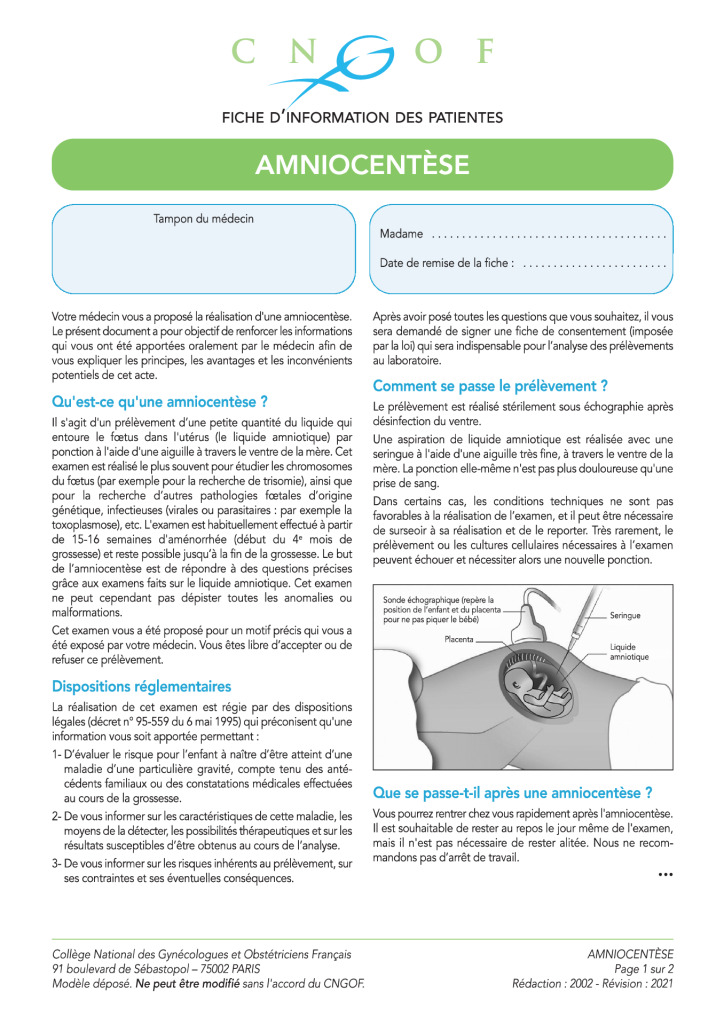
This involves taking a small sample of the fluid surrounding the fetus in the uterus (amniotic fluid) by puncturing it with a needle through the mother's abdomen. This test is most often performed to study the fetus's chromosomes (for example, to screen for Down syndrome), as well as to screen for other fetal pathologies of genetic or infectious origin (viral or parasitic: for example, toxoplasmosis).
The test is usually performed from 16 weeks of amenorrhea and remains possible until term. It is carried out during a prenatal diagnostic consultation. The purpose of amniocentesis is to answer specific questions through tests performed on the amniotic fluid.
This test does not detect all possible abnormalities or malformations. This test was recommended for a specific reason, which your doctor explained to you. You are free to accept or refuse this procedure.
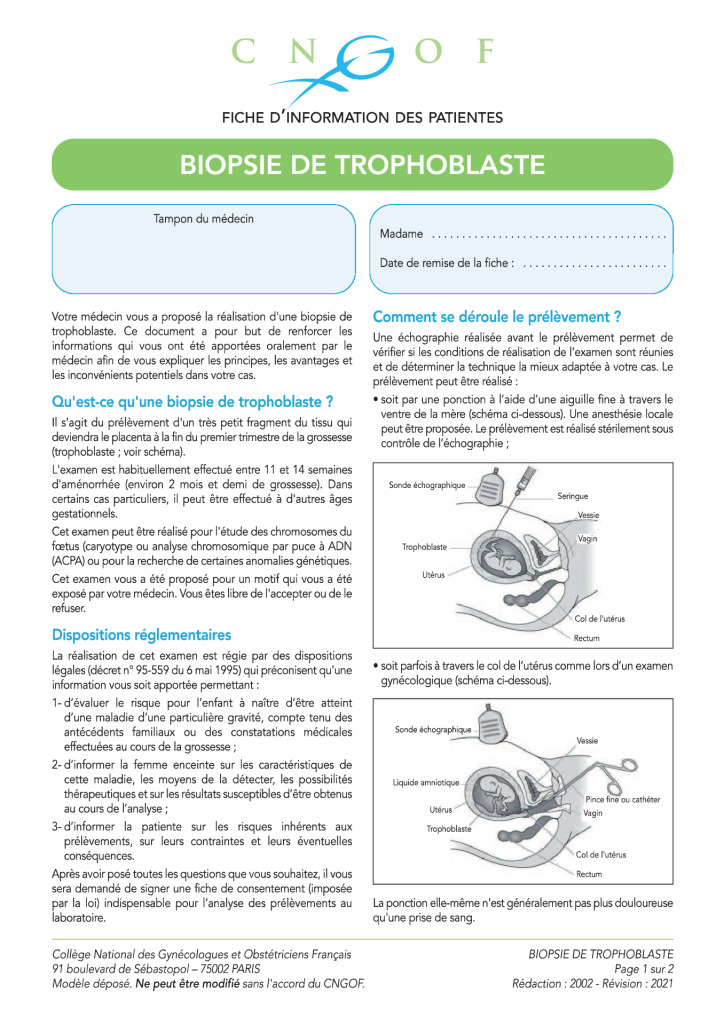
This involves taking a very small sample of what will become the placenta at the end of the first trimester of pregnancy. The examination is usually performed between 11 and 16 weeks of amenorrhea, during a prenatal diagnostic appointment.
This test can be performed to study the chromosomes of the embryo (karyotype) or to search for certain genetic abnormalities.
This test has been recommended to you for a reason explained to you by your doctor. You are free to accept or refuse this procedure.


